
Anyone using SCORM in a business setting quickly runs into questions that go beyond the basics: Which SCORM version is the right one? How does SCORM differ from xAPI? And what exactly is "dynamic SCORM"? This article covers these questions in detail.
SCORM 1.2 vs. SCORM 2004: The Key Differences
SCORM 1.2 and SCORM 2004 are the two versions of the standard relevant in practice. They differ in several technical respects:
- Interaction model: SCORM 1.2 works with a pure write model, in which the course sends data to the LMS. SCORM 2004 additionally allows read access, so a course can also retrieve data from the LMS.
- Status logic: SCORM 1.2 has a single status ("Lesson_Status"). SCORM 2004 splits this into Completion_Status (whether the course was worked through) and Success_Status (whether it was completed successfully), enabling more differentiated reporting.
- Sequencing: Only SCORM 2004 allows fixed learning paths and access rules to be defined within a course, for example to unlock chapters only after previous chapters have been completed.
- Reporting depth: SCORM 2004 delivers overall more granular data on learning progress and interactions.
- Compatibility: SCORM 1.2 is supported by practically every LMS, whereas SCORM 2004 is not always fully supported. It is worth checking the LMS documentation before deployment.
For companies without complex requirements for learning path control, SCORM 1.2 is often the more pragmatic choice due to its broader compatibility. Those who need differentiated reporting or controlled learning paths benefit from SCORM 2004.
SCORM, xAPI, and cmi5 Compared
Alongside SCORM, two further standards have become established: xAPI (Experience API) and cmi5. xAPI can also capture learning activities outside a traditional LMS, for example in simulations, apps, or in the workplace, and sends data to a so called Learning Record Store (LRS). cmi5 combines the technical flexibility of xAPI with a standardized structure similar to that of SCORM, and is considered a possible successor for environments that need more tracking depth than SCORM offers.
In practice, SCORM remains the standard with the broadest LMS support due to its prevalence. For companies whose LMS does not support SCORM but only xAPI, it is worth noting that modern authoring tools can also provide content directly in xAPI format, without a separate conversion step being necessary.
What Is Dynamic SCORM?
Classic, static SCORM is based on a fixed ZIP file: on export, a snapshot of the course is created and uploaded to the LMS. Every content change requires a new export and a new upload, which quickly becomes cumbersome with frequent updates, multiple language versions, or many LMS instances.
Dynamic SCORM, on the other hand, takes a different approach: instead of a static copy, a connection is established between the authoring tool and the LMS. Changes to the course in the authoring tool are automatically made available to learners without the course having to be exported and uploaded again. The one time upload remains in place, but the content behind it is kept continuously up to date. In short: the course can continue to be adjusted in the authoring tool even after export, and these changes go live in the LMS automatically, without a new SCORM file having to be exported and uploaded.
Static vs. Dynamic SCORM at a Glance
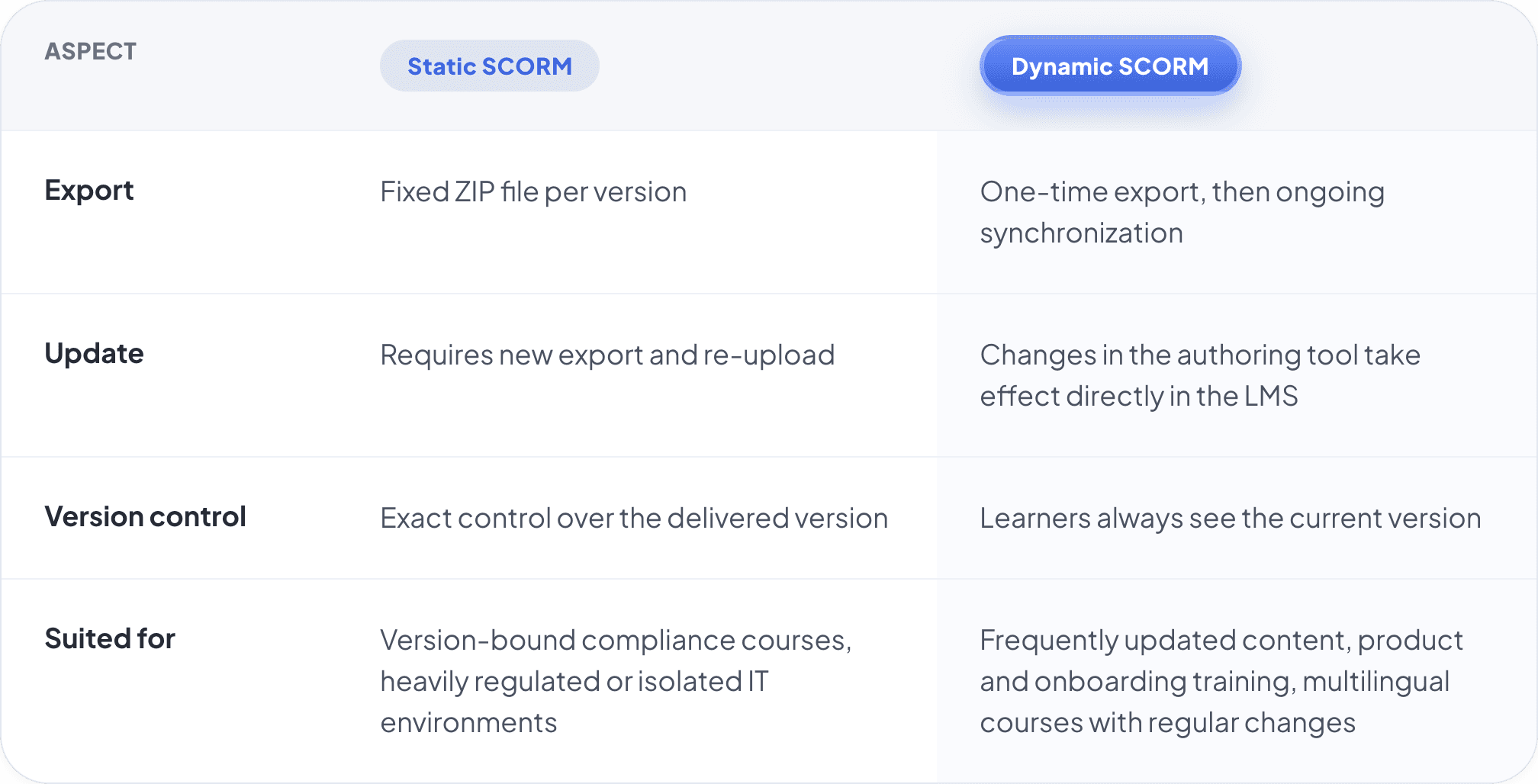
Both approaches have their place. For compliance training, where a specific, approved course version must be verifiably delivered, static SCORM is often the right choice. For content that changes frequently, such as product training or onboarding material, dynamic SCORM significantly reduces the recurring maintenance effort, since a full export, review, and upload cycle is not needed for every small change.
Multilingual Support: One SCORM Package for Multiple Languages
An often underestimated problem in practice is multilingual support. Many authoring tools export a separate SCORM file for each language version of a course, which then has to be uploaded to the LMS and managed individually. For courses in five or more languages, that means five separate packages, five upload processes, and five places where updates need to be applied. Alternative approaches bundle multiple language versions into a single SCORM file, so learners can select the appropriate language directly within the course, without multiple packages having to be maintained in parallel. This noticeably reduces the administrative effort in the LMS, especially for training used internationally.
Dynamic SCORM—for you, too
Looking for a solution that combines dynamic SCORM and multilingual support? Take a look at what we offer.
Public Link: Sharing Courses Without SCORM and an LMS
Not every use case requires going through SCORM and an LMS. Elephant therefore also offers the option of making a course available via a public link. This lets the course be accessed directly via a link, without a prior SCORM export and without an LMS upload. This is relevant for situations where no LMS tracking is needed, for example when quickly sharing a course with external contacts, partners, or prospects.
Elephant's Approach: Auto Sync, Multilingual Support, and xAPI Combined
Elephant combines these concepts within its own authoring environment: content updated in the authoring tool is automatically mirrored in the LMS, without a new export or upload (auto sync). Multilingual courses can be represented in a single .scorm file instead of maintaining a separate package for each language, and the appropriate language can then simply be selected. And for companies whose LMS relies on xAPI instead of SCORM, the same course content is also available in xAPI format. Combined, this significantly reduces the recurring maintenance effort for frequently updated training content used internationally.
Conclusion
SCORM 1.2, SCORM 2004, xAPI, and cmi5 differ in technical depth and intended use, and dynamic SCORM fundamentally changes how updates flow between the authoring tool and the LMS. Which combination makes sense depends on update frequency, compliance requirements, and the number of language versions needed.