The skilled worker shortage hits production, logistics, and field service harder than any other area. Many companies' answer: recruit internationally. L&D's response follows logically: build multilingual courses, translate content, set up the platform, finalize the onboarding concept. And then the new hire has been waiting ten weeks for their residence permit.
This is not an isolated case. It is structural reality. The question is not whether digital onboarding for international employees makes sense. The question is: at what point in the process does it begin? And who actually thinks that through?
Digital Onboarding for International Employees: What L&D Teams Build
Around half of all employees in Germany work in frontline roles: production, logistics, healthcare, hospitality. These teams were simply ignored by classic HR and L&D tools for decades. Anyone building digital learning infrastructure for multilingual frontline employees today is doing something right. But there is a blind spot.
Why Onboarding International Employees Often Starts Too Late
Onboarding international employees is structurally more complex than onboarding local talent. Full integration from contract signing to independent work readiness takes three to six months. The visa process alone takes four to twelve weeks depending on the country of origin. Add to that:
Recognition procedures for foreign professional qualifications Government appointments, apartment searches, school places for accompanying families
Anyone developing an onboarding plan that starts on the first day of work is planning around reality. The first day of work often comes weeks later than planned. Or the employee is physically there, but cognitively and emotionally occupied with ten other issues that have nothing to do with professional onboarding.
Multilingual training launched at this moment has poor chances. Not because the content is bad. But because the timing is wrong.
Pre-Boarding for International Frontline Employees: The Decisive Lever
If the bottleneck lies before the first day of work, digital learning support has to start exactly there. Pre-boarding means: the new employee gets access to relevant content before they even start. Not the full training program, not mandatory compliance modules. But what makes sense during the waiting period: an introduction to the company, first language basics for the working environment, safety instructions in their native language.
This reduces cognitive load on the first day of work. It builds engagement before someone has even clocked in. And it uses the waiting time that would otherwise simply pass unused.
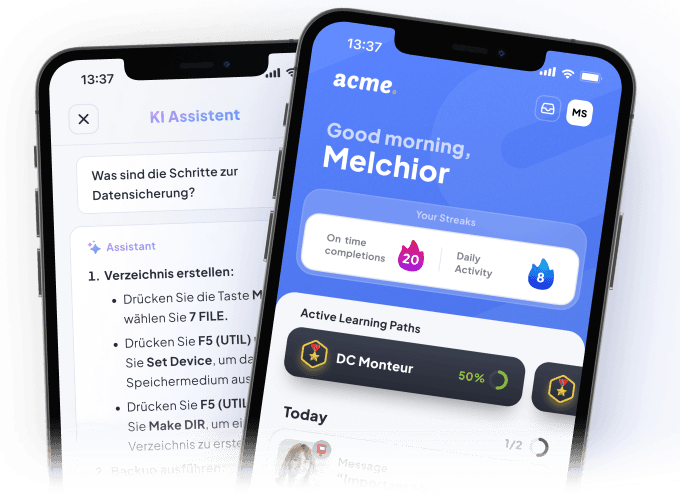
The key advantage of modern frontline learning platforms: a smartphone is enough. No company login, no installed app, no IT ticket. Training starts wherever the employee currently is.
Improving Onboarding for Multilingual Employees: 4 Measures for L&D Teams
1. Start the onboarding process before the first day of work
Not with the full learning path, but with targeted content that provides orientation during the waiting period. A short video on company culture, an overview of the team, first safety instructions in the native language. Low effort, measurable impact: companies with structured pre-boarding reduce early turnover by up to 20% within the first 45 days.*
2. Treat multilingualism as a standard, not an add-on
Multilingual content only works if it is built for frontline teams from the start: short, visual, accessible on a smartphone. No long body text, no complex menu structures. Content that someone in the production hall or warehouse actually interacts with, not just clicks through.
3. Make the timeline realistic
An onboarding concept that depends on a smooth government process is not a robust concept. L&D teams who work closely with HR and Operations know early on when a new hire will actually start. That knowledge has to feed into the learning plan.
4. Redefine success
Time-to-productivity is a more complex metric for international frontline employees than for office workers. Classic onboarding timelines do not apply here. More useful: track engagement in pre-boarding content, measure completion rates in the first four weeks, collect qualitative feedback at 30 and 60 days, and compare early turnover with employees who had no structured pre-boarding.
Digital Onboarding for International Employees: Rethinking the Timeline
L&D rarely takes the wrong step when onboarding international employees. Usually it is the right step at the wrong time.
Digital learning support for multilingual frontline teams is not a nice-to-have. It is one of the few levers L&D actually controls when government agencies and visa processes set the pace. But it only works when it starts where the employee currently is, not where the onboarding plan wants them to be.
*Healthy Office Habits, 2024