
Classic knowledge management systems were built as archives. Knowledge in, knowledge out. LMS, SharePoint, and internal wikis measure clicks and course completions, but not understanding. They show what has been uploaded, not what is needed. For frontline teams who work on the go and don't have a company laptop, many of these systems are out of reach entirely. The blind spot is not created by missing content. It is created by missing feedback between what L&D produces and what teams actually need in practice.
What L&D Teams Lose as a Result
The consequences of a missing feedback loop are rarely visible in any dramatic way. They accumulate quietly. Content becomes outdated without anyone noticing, processes change, but no one reports that the training still shows the old version. The worker on the construction site follows instructions that no one has updated in two years, and has no idea.
Knowledge gaps surface as errors, not as learning opportunities. When an installation error happens, it might be because the relevant step is not clearly explained in any course. But without a feedback loop, L&D only sees the error, not the underlying cause. The result: L&D teams keep creating more content without knowing whether what already exists actually works.
What a Closed Feedback Loop Changes in Knowledge Management
A closed feedback loop means every interaction an employee has with the knowledge management system becomes a data point. What questions are being asked? What answers are missing? Which content gets accessed frequently, and which never? Where are multiple people asking the same thing, pointing to a systematic knowledge gap? Aggregated, these data points tell a story no LMS report has ever told: what teams genuinely do not know. Not what they have checked off, but where they actually get stuck in their day-to-day work. And just as importantly: which knowledge actually lands? Is a piece of content accessed, but a question still asked right after? Then it is not explaining what is actually being asked. A feedback loop does not just make gaps visible. It shows whether what already exists actually works. That changes how knowledge management is run. No longer create once and hope it sticks. Instead, improve iteratively based on real usage data.
How AI Closes the Feedback Loop for Frontline Teams
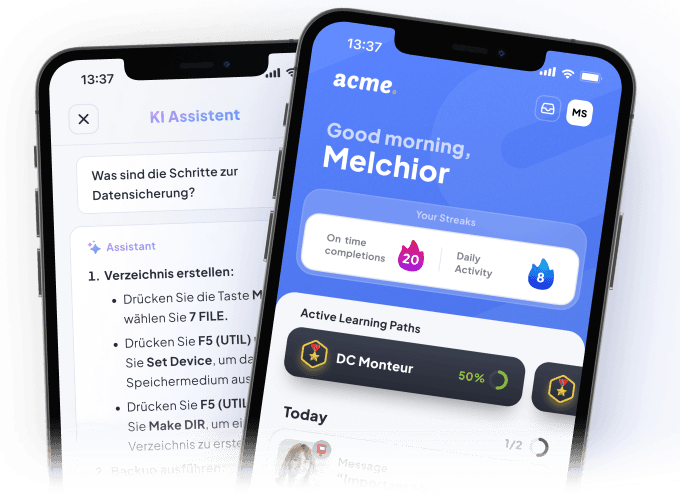
The decisive step is not to expect the feedback loop from employees, but to close it technically. An AI assistant that answers questions directly on the smartphone creates this loop automatically. Every question asked becomes visible, not as an individual request, but aggregated as a pattern. If a team in production asks about the same process step three times a week, that is a clear signal: either content is missing, or the existing content does not explain what is actually being asked.
Elephant makes exactly that visible. The AI assistant answers questions based on approved company content, and the reporting shows what teams genuinely do not know as a direct basis for targeted content maintenance. SOPs get automatic expiration dates so outdated processes do not go unnoticed in the system. When a linked document in SharePoint or Confluence changes, Elephant automatically updates the training content along with it.
What L&D Teams Can Change Right Now
1. Make questions visible before errors happen
Anyone who wants to know where knowledge gaps exist has to stop waiting for error reports. An AI assistant that aggregates questions delivers this information proactively. The question "What are our teams actually asking?" should be just as standard as the question "How many courses have we completed?"
2. Maintain content iteratively instead of creating it once
Knowledge management is not a project with a completion date. Content that is accurate today may be outdated in six months. A structured process that regularly evaluates usage data and updates content based on feedback signals is more efficient than annual content audits that no one sees through.
3. Treat usage data as a quality signal
Course completion rates say little about whether knowledge is actually applied. More relevant signals: which questions are asked repeatedly? Which content has high view counts but still generates follow-up questions? Where does the AI assistant return no answer because no content exists? These data points show where L&D should actually be investing.
Conclusion: Knowledge Management Without a Feedback Loop Is Built on Guesswork
Anyone creating content without knowing whether it works is optimizing in the dark. For frontline teams who have no time for structured feedback and whose working reality differs fundamentally from classic office jobs, a technically closed feedback loop is not a nice-to-have. It is the prerequisite for knowledge management to work at all.