
80 percent of all employees worldwide have no fixed desk. They work in production, field service, and logistics. Their knowledge is not stored in documents — it lives in years of hands-on practice. And a large share of them will retire in the coming years.
You know this. You want to secure that knowledge before it walks out the door. But this is exactly where the mistake happens. Not for lack of intent. But because almost every L&D manager starts with the same first step — one that sounds intuitively right but structurally fails for this audience.
Why Frontline Teams Are a Special Case in Knowledge Management
Around 80 percent of all employees worldwide are part of operational teams: people who work in production, logistics, field service, or technical outside service. They have no fixed desk, no company laptop, no Confluence access, and no habit of putting their knowledge into written form.
This is not a deficit — it is simply a different way of working. These people have built their knowledge through years of practice, through touching, observing, and trying things out. They know what a machine sounds like when something is wrong. They know which step can be skipped and which cannot. This knowledge is real, it is valuable, and it is completely different in nature from what ends up in a SharePoint folder. Classic knowledge management approaches were developed for L&D employees: people who sit at a computer every day, write documents, and maintain wikis. Applied to frontline teams, they fail reliably.
The One Critical Mistake: Starting with Documentation Instead of Extraction
The most common first step L&D managers take looks like this: they ask experienced employees to write down what they know. They set up a SharePoint folder, create templates for process documentation, maybe an internal wiki. What happens: the documents stay empty. Or they get filled in half-heartedly and are outdated six months later. Or they do get created, but no one reads them because they are too abstract to help in a concrete situation at the workplace.
The problem is not lack of motivation. The problem is that operational employees do not think their knowledge in text form and do not retrieve it in text form either. Someone who has maintained a system for twenty years cannot simply translate that knowledge into a document framework. It lives in their hands, in their routine, and in their feel for the right moment. Documentation as a first step places the responsibility for knowledge extraction on the person who holds the knowledge. That is the wrong approach. Extraction has to be actively designed, not passively expected.
What Works Instead: Capturing Knowledge Where It Is Created
The right first step is not documentation, but extraction. And that does not happen at a desk — it happens directly in the work context. In concrete terms: you go to the machine, the system, the job site. You do not ask "write down what you know," but "show me what you do." A guided POV recording, in which someone walks through a process once and explains what they are doing and why, delivers more usable knowledge in ten minutes than a document that never gets finished.
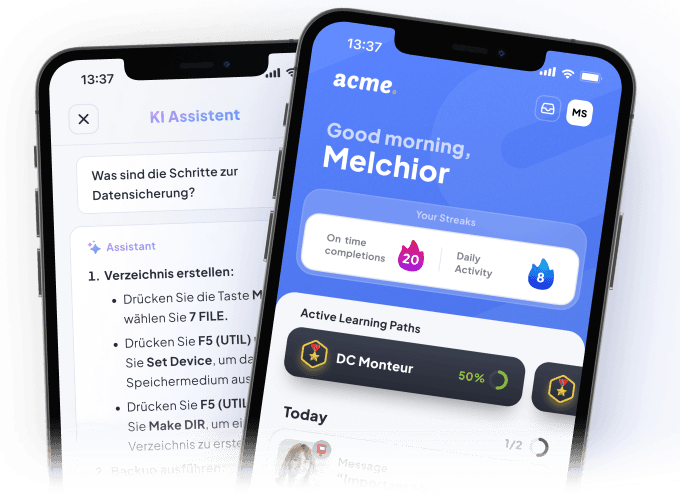
The decisive difference: the format fits the audience. Frontline employees do not retrieve knowledge through text documents. They retrieve it through video, audio, and visual instructions — on their smartphone and at the moment they need it. What is created in this format actually gets used. AI can significantly accelerate this process today: from a guided interview or a POV recording, structured learning modules are generated automatically — searchable, multilingual, accessible on a smartphone. What would have taken weeks of instructional design effort before now takes minutes.
How to Successfully Secure Knowledge
1. Identify critical processes
Not all knowledge is equally urgent. Which workflows are particularly error-prone? Which depend on individuals who will leave the company in the coming months? Which processes are hard to learn and documented nowhere? These questions give the initiative focus and prevent the project from losing scope before it has really started.
2. Find the right knowledge holder
Not everyone with long tenure is automatically the decisive knowledge holder. What matters is who holds the knowledge that exists in no manual. Who knows how system 4 really runs, which shortcuts work, and which mistakes only experience lets you recognize. Only 15 percent of companies have a structured process for this. Anyone who identifies these people too late will get no useful answers.
3. Actively extract knowledge
No "write everything down." That structurally does not work for frontline teams. What does work: structured interviews and POV video recordings directly at the workplace. In 45 to 90 minutes, more usable material is produced than in a document that never gets finished. Questions like "show me what you do" instead of "explain what you know" make the difference. Ellie automatically extracts processes, steps, and workarounds from this and turns them into finished learning paths — retrievable directly on the smartphone.
Conclusion: Getting the First Step Right Makes All the Difference
Securing the knowledge of operational employees is solvable. But it requires a different approach than the knowledge management L&D teams know from the office world. The one mistake to avoid: relying on self-documentation instead of actively extracting. Anyone who gets this step right builds something in a matter of weeks that actually works.