
Companies with multiple locations know the problem: a new compliance update reaches headquarters immediately, the branch in Munich three weeks later, and the plant in Poland only after someone asks by email. Every location trains a little differently, every manager interprets the rules a little differently, and in the end no one knows exactly who is at what stage. This pattern is not the exception.
For HR leaders in a management role, this is more than an organizational annoyance. It is also a risk to compliance, service quality, and employee retention. Here you'll learn why training across multiple locations is so difficult, what current studies show about the status quo, and which criteria matter when choosing the right learning platform.
Why Training Across Multiple Locations Is So Difficult
Training is a sensitive topic, and with every additional location the complexity grows disproportionately. Different managers, shift schedules, hiring periods, regional regulations, and role-specific requirements quickly add up, without central coordination, to a fragmented system: clean onboarding here, only a brief walkthrough there, fully documented mandatory training here, only partially tracked training there. New processes also take weeks or months to reach every location.
The consequences are concretely measurable:
- New employees become productive more slowly because they have to wait for trainers, materials, or fixed course dates.
- In regulated industries such as financial services, healthcare, manufacturing, or retail, a compliance risk arises the moment one location misses a deadline, because responsibility ultimately falls on the whole company.
- Customers experience a different service standard depending on the location.
- HR teams lose a lot of time on manual follow-up: reminder emails, spreadsheets, certificates, status check-ins with managers.
The larger the company, the less this can be managed with spreadsheets and email distribution lists.
Classic in-person training makes the problem worse: trainers have to travel, rooms have to be booked, travel costs and downtime add up, and a single date rarely works for all shifts at once. Digital, centrally managed learning offerings shift these fixed costs into flexible, location-independent formats. In-person training still makes sense where hands-on practice or personal exchange matters, for example in skilled trades or leadership development. For everything else, the platform carries the base load.
What Current Research Shows
The "Weiterbildungsstudie 2025" ("2025 Continuing Education Study") by HRpepper and the Bitkom Akademie (1,057 respondents, not representative, but informative) shows:
- 79 percent see continuing education as central to their development
- 74 percent link it to business success
- 86 percent see it as a fixed part of everyday working life
- only 49 percent perceive a clear training strategy at their employer
This gap between expectation and practice is further amplified across multiple locations, since every additional structure, such as branches, plants, or remote work, increases the coordination effort.
According to several independent market research firms, the international LMS market is growing at a double-digit rate per year. The often-cited figure "83 percent of all companies use an LMS" could not be confirmed in the cited Statista source and is deliberately not adopted here.
Relevant for AI-supported learning: according to the same study, 54 percent of working professionals have already used AI to acquire new professional knowledge, as a supplement, not a replacement, for vetted, centrally maintained learning content.
Six Criteria for Choosing the Right Learning Platform
Not every learning platform is built for teams spread across multiple locations. When choosing one, it's worth looking at six concrete functional areas.
- Dedicated learning environments per unit: regional offices, branches, franchise partners, or international subsidiaries often need their own branding, their own course catalogs, and their own local administrators, while headquarters still retains full overview. A platform with multi-tenancy, or separate portals per location, resolves this tension between local flexibility and central control.
- Role-based learning: employees rarely need identical content. A good platform automatically assigns courses by role, department, location, experience level, or management responsibility, instead of every assignment being done manually.
- Standardized learning paths for recurring programs such as onboarding, leadership development, or annual mandatory training on data protection, workplace safety, or compliance. Learning paths ensure that every location goes through the same foundational training, while still allowing local additions.
- Real-time progress tracking and reporting: managers overseeing multiple locations need to see at a glance where training is overdue, which certifications are expiring, and what the overall compliance status looks like, without having to ask each local team individually.
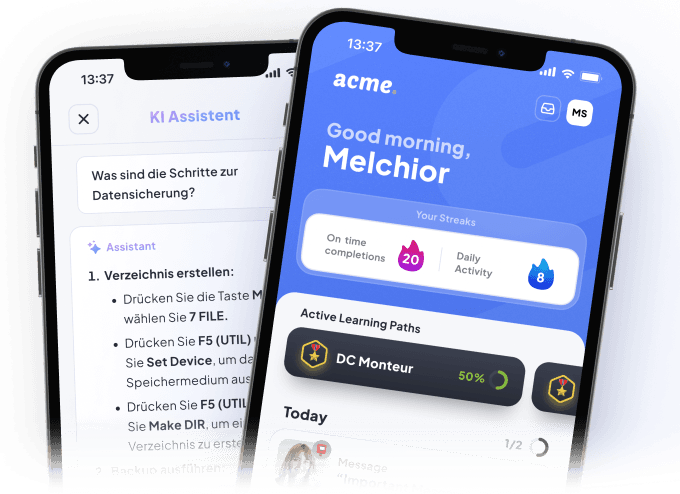
- Mobile and time-independent use: shift work, different time zones, and field-based roles require learning content that also works from a smartphone and outside fixed working hours. According to current market data, well over half of learners already use mobile devices for their training, and this share is rising.
- Scalability without extra effort: setting up a new location should take just a few steps (create users, assign a learning path, name a local administrator), rather than rebuilding the entire training program from scratch. This is exactly what distinguishes a platform that can grow with the company from a standalone solution that hits its limits at the next expansion.
Legal and Organizational Points Before Rollout
Beyond choosing functionality, there are points that should be clarified before rollout, precisely because different local conditions and, in some cases, different works council structures come together across multiple locations:
- Devices: are employees allowed to use personal smartphones, or are company devices provided, and is there an equivalent alternative for employees without their own smartphone
- Data protection: what usage and learning-progress data is processed, who has access, and is there a sound data protection basis behind it
- Co-determination: where a works council exists, it should be involved early, especially for features such as performance or behavior monitoring via reporting dashboards
- Working time: a clear policy on availability and learning time outside working hours prevents training from becoming an unpaid additional task
These four points should be clarified before every rollout.
Do you have questions about your rollout?
What exactly might the rollout look like at your company, and what do you need to keep in mind? We'll explain it all to you.
Typical Rollout in Four Steps
Introducing a centralized learning platform doesn't have to be a large project with an uncertain outcome. In practice, a step-by-step approach works well.
The first step is a stocktake: which training is already mandatory at which location, where are there duplications, and where are documented records missing entirely. This stocktake reveals how large the actual gap between expectation and reality is, before a platform is even selected.
The second step defines a binding core program that applies equally to all locations: onboarding, workplace safety, data protection, and other mandatory topics. This core program forms the foundation on which local additions are later built.
The third step is a pilot location. A single location or region tests the platform, learning paths, and reporting processes in live operation before the rollout is extended to all other locations. This makes it possible to catch pitfalls early instead of repeating them at scale.
The fourth step is the phased rollout with accompanying change management: local managers are involved, successes from the pilot are made visible, and the platform's value is measured concretely against metrics such as onboarding duration, completion rate, or the number of overdue mandatory training sessions.
From Theory to Practice: What Matters Now
Technology alone doesn't solve the problem. A learning platform only becomes effective through clear ground rules: a binding core program for all locations, supplemented by local content, oversight of open training via a dashboard instead of spreadsheets, current content instead of outdated manuals, and a learning culture in which managers themselves visibly learn, rather than merely demanding it of others.
The HRpepper study confirms this last point: the main obstacle to training is usually not a lack of motivation, but a lack of space for it in everyday work and a lack of role models in leadership positions.
A common mistake is to map out every location individually from the start, which creates exactly the complexity that should be reduced. Better: a lean core program first, with local adaptations only afterward and only where truly necessary, for example due to regulations or language. Change management is equally important, because even the best platform remains ineffective if managers don't use and champion it themselves.
For companies with multiple locations, a centralized learning platform is therefore not an IT project, but a strategic decision for compliance, onboarding speed, service consistency, and employee retention.
Transition CTA: This is exactly what Elephant Company's learning platform is built for: a central hub for teams across multiple locations, with local flexibility. Interested? Feel free to reach out to us.
Sources:
- Weiterbildungsstudie 2025, Bitkom Akademie and HRpepper (primary source, key findings officially published)
- Summary of the study presentation, Corporate Learning Community (secondary source, not all figures confirmed against the primary source)
- How Do You Train Employees Across Multiple Locations?, LMS Portals
- Learning Management System (LMS) Statistics, Citrusbug (market data, partly cited secondhand)