Picture a mid-sized metalworking supplier facing its ISO 9001 recertification audit. In the meeting room, everything goes well: the quality objectives are documented, the internal audit reports are ready, and the quality manager has an answer to every question. Then the auditor heads out to the production line. At a press, she asks the operator how he sets up the tool and where the work instruction for it is. He pulls a binder out of a cabinet, leafs through it for a while and finally shows her an instruction from 2019. Since then, the press has been fitted with a new control system, the settings described no longer match, and the operator has long been following a process a colleague showed him. The example is fictional, but typical.
Moments like this lead to audit findings, even when everything is in order in the quality office. The problem is not that the instruction is missing, but that it is outdated and no longer matches the actual process. Audit-proof therefore does not simply mean “documented”, it means “correct at the workplace and verifiable”.
In this article, you will learn what ISO 9001 actually requires of work instructions, what is mandatory and what is not, and where auditors look closely. We also show you how digital work instructions make it easier to provide evidence, and you get a checklist plus a four-step process to prepare your work instructions for your next audit.
What does audit-proof mean for work instructions?
In an audit, what counts is less how neatly a work instruction is formatted or whether it matches your corporate design, and more whether it works in everyday practice. A work instruction is audit-proof if it answers three questions:
- Is it valid? Version, approval and date are clearly visible.
- Is it available? The person at the workplace finds the current version when they need it.
- Is it effective? Employees know it, work according to it, and you can prove both.
Most companies meet the first point, because version, date and approval are easy to control from the quality office. Findings arise from the second and third points, where the document meets day-to-day work. That is exactly what happened in the example at the press: the instruction had a version and a date, but it no longer matched the machine, and the operator was following a different process anyway.
It also matters which document you are looking at. A procedure governs a process across several roles, meaning who is responsible for what and when. A work instruction goes one level deeper and describes how someone carries out a single task at their workplace. Conversations on the shop floor are usually about this second level. How you structure your work instructions therefore helps decide whether they answer the three questions from the start.
What ISO 9001 requires for documented information
Since the 2015 revision, the standard no longer speaks of “documents” and “records”, but of “documented information”. It distinguishes between two types:
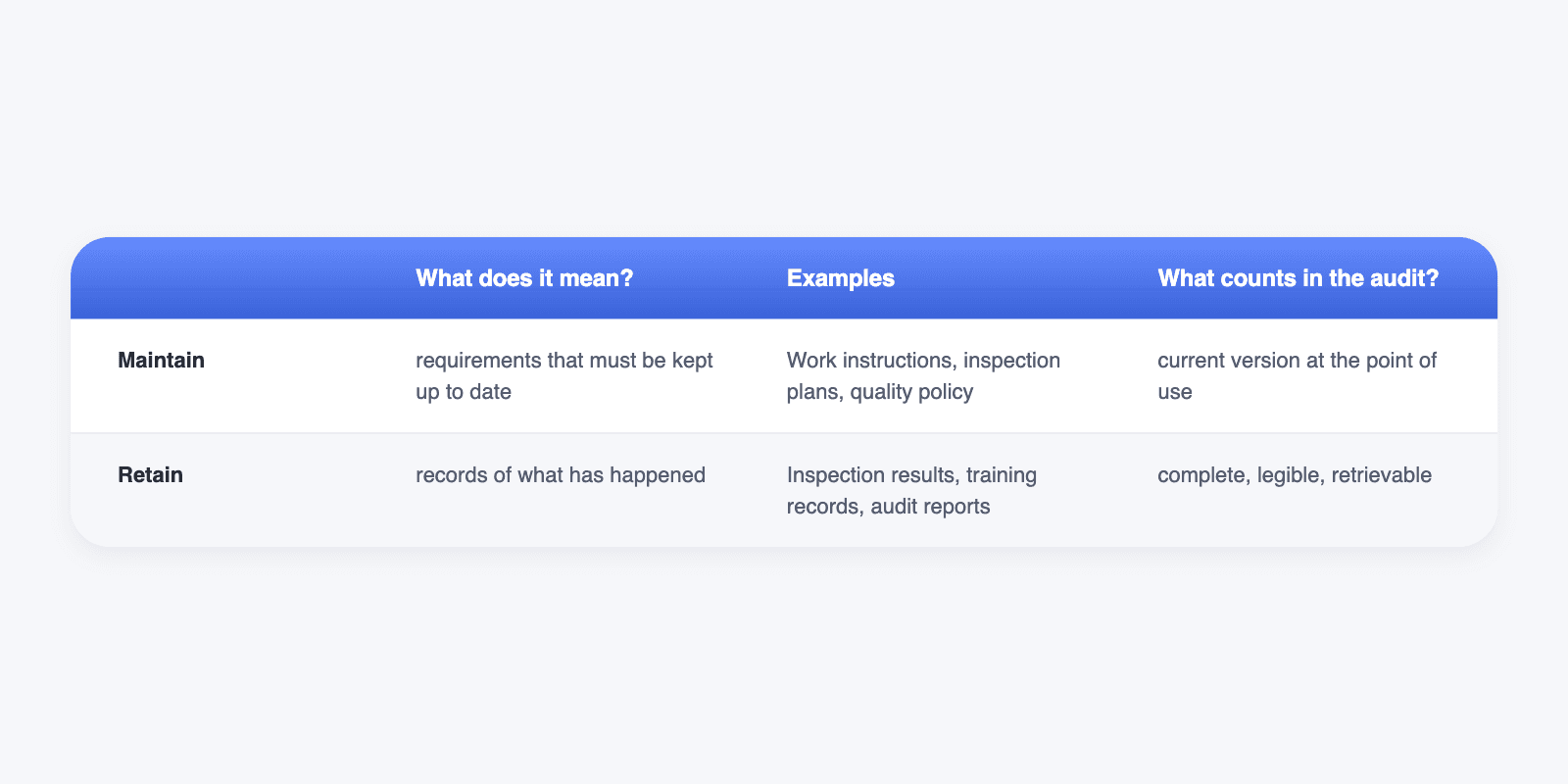
For work instructions, three clauses of the standard are especially important.
4.4 and 8.1: Controlling processes: The organization maintains documented information to the extent necessary for processes to run as planned. How much is necessary is up to the company itself, for example depending on its size, complexity and the competence of its employees. So the standard does not require every process to be documented, it deliberately leaves you room for judgment.
7.5.2: Creating and updating: Documents need identification (such as title, date, author, number), a suitable format and medium, and a review and approval.
7.5.3: Control: Documents must be available where and when someone needs them. This also covers protection, access, distribution, storage, version control and retention.
Important in practice: the standard does not prescribe a medium. A work instruction can be on paper, digital, a sequence of images or a video.
Myth check: what is mandatory and what is not?
A number of myths persist around documentation requirements, many of them dating back to the 2008 version. The following overview shows what is actually mandatory.
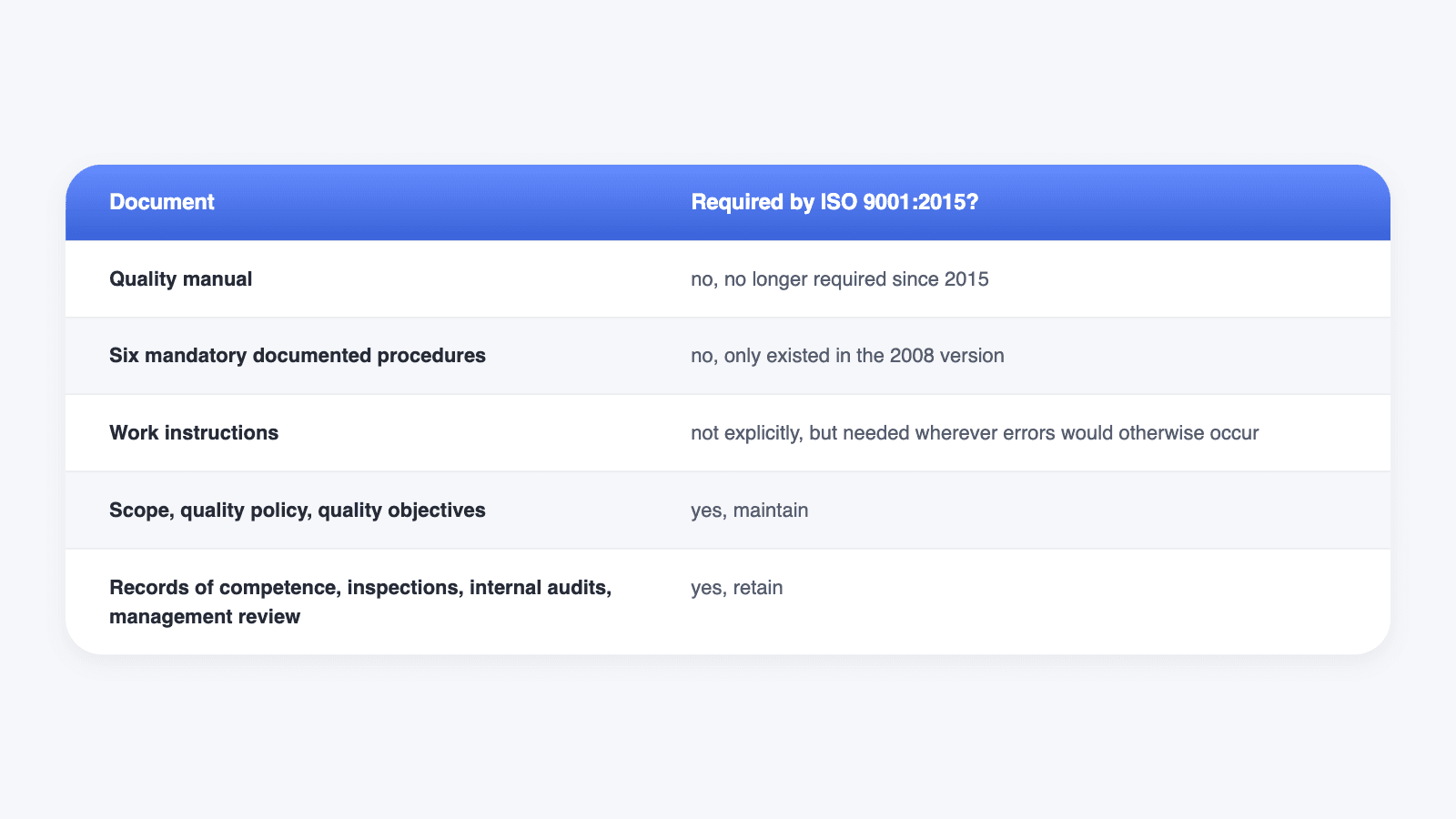
In other words: you decide which tasks require a work instruction. In practice, a work instruction is worth it above all where errors have costly or safety-relevant consequences, where a task is rarely performed and therefore never becomes routine, where many people take turns working on the same machine, or where new employees need to get up to speed quickly. But if there is one, it must be controlled, and you always need evidence of your employees’ competence. The quality manual is no longer mandatory, but it can still be useful as an overview of your management system.
Typical weak spots in work instructions
In audits, work instructions rarely stand out because of their content. What they say is usually correct, or at least it was at some point. Problems arise where the document meets practice, and these six weak spots come up again and again:
- Outdated version at the workplace. Version 4 is approved in the quality management system, but version 2 is still posted at the machine.
- No visible approval. Nobody can say who reviewed the instruction.
- Instruction and practice differ. Employees work differently from what the instruction says because the process has changed.
- No record of instruction. The work instruction exists, but you cannot prove who knows it. ISO 9001 clause 7.2 requires you to ensure the necessary competence of your employees, evaluate the effectiveness of actions such as training, and retain documented information as evidence of competence. A documented briefing is the obvious evidence for this. In Germany, the statutory duty to instruct employees under Section 12 of the Occupational Safety and Health Act (ArbSchG) and Section 12 of the Ordinance on Industrial Safety and Health (BetrSichV) also applies to machines and other work equipment. Both require instruction before the work begins, and under Section 12 BetrSichV you must record the date and the names of the people instructed in writing.
- Cannot be found. The person at the workplace does not know where the instruction is.
- External documents not controlled. Manufacturer manuals or customer specifications are lying around in old versions.
What stands out is that most of these weak spots relate to availability and effectiveness, the second and third points from above. They rarely come from carelessness, but from the fact that machines, materials and processes change faster than the documents that go with them. You will find out whether your work instructions are affected at the latest when auditors ask questions directly at the workplace.
The questions auditors ask at the workplace
An audit is not just a document review. Auditors check whether your management system meets the requirements of the standard and works in everyday practice. To do this, they review documents and evidence and talk to the people on site, meaning employees right at their workplaces.
These conversations do not happen just once. An ISO 9001 certificate is usually valid for three years, with annual surveillance audits in between, followed by recertification. On top of that come internal audits, which you plan yourself at fixed intervals. So your work instructions have to be right not just on one particular day, but all the time.
Typical questions auditors ask at the workplace include:
- “How do you carry out this task?”
- “Where do you find the instruction for it?”
- “How can you tell that this is the current version?”
- “What do you do if the result is not right?”
- “When were you last briefed on this?”
If your employees can answer these questions confidently and their answers match the instruction, the most important part is done. That is exactly what went wrong in the example at the press: the operator could explain his process, but it did not match the instruction in the binder. That is why it pays to ask these questions yourself before the audit. Often the cause already lies in the medium, the binder at the machine.
Digital evidence instead of binders
Paper work instructions have a fundamental problem: you can never be sure which version is posted at which machine. Every change means reprinting, swapping and hoping nobody keeps an old copy. Evidence of how someone actually carried out a task is usually missing altogether, or it is buried in forms you first have to hunt down during the audit. Anyone who has gone through binders shortly before an audit knows the feeling.
Digital SOPs can solve both problems. With Elephant’s SOP Generator, the approved version is available digitally instead of as a printout at the machine. Your employees carry out the instruction in the app on a smartphone, tablet or in the web browser, and checklists record the execution directly. That way, the evidence is created at the same moment as the work:
- Photos as evidence for visual inspections
- Input fields for measured values
- Signatures for confirmation
The AI creates the draft of an SOP from a video of the task. This keeps the documentation closer to the real work, because it starts from the actual process and not from what someone writes down from memory. We show you in detail how to create an SOP with AI in a separate article.
Through the login, you can also roll out SOPs by role and location by assigning them to specific teams, roles or individuals. This lets you decide, for example, who receives the work instruction for a particular machine, such as only after they have been briefed. The briefing itself can be set up as mandatory training with a certificate, so it is always clear who has been briefed.
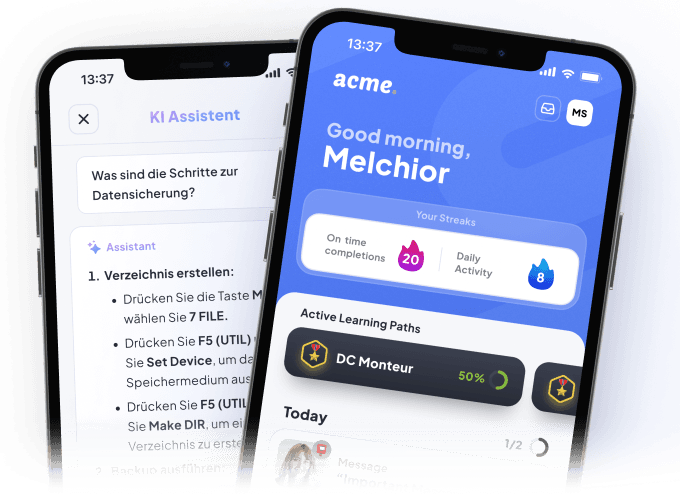
So when the auditor at the press asks for the work instruction, the operator no longer pulls a binder out of the cabinet. He opens it in the app.
The auditor asks for the instruction. Your team opens the app.
With the Elephant SOP Generator, every workstation has the approved version, and photos, measured values and signatures are captured right as the work gets done. No binder, no searching, no outdated versions.
Checklist: making work instructions audit-proof
Digital or paper: use the following checklist to see whether your work instructions answer the three questions of validity, availability and effectiveness. Ideally, go through it not just at your desk but at the workplaces themselves, because many points can only be honestly checked off there:
- Every work instruction has a title, number, version, date and approval.
- Only the current version is available at the workplace.
- Old versions are archived and marked as invalid.
- Every instruction has a person responsible for it.
- You review every instruction for currency at fixed intervals.
- The instruction and the actual process match (spot-check on site before the audit).
- The briefing of everyone affected is documented.
- Results of inspection steps are retained as evidence.
- External documents are recorded and up to date.
- Employees know where to find the instruction.
You can also find all checkpoints in our audit checklist for SOPs (link anchor V4) as a free download, so you have them at hand for your next preparation.
Audit preparation in 4 steps
A checklist shows you what has to be right in the end. To keep your preparation from getting stuck in the last few days before the audit, a clear four-step approach helps:
- Take stock: List all work instructions with version, approval date and the person responsible.
- Check on site: Go to three to five workplaces and ask the auditor questions above.
- Close the gaps: Update instructions that differ from practice and add missing ones.
- Bundle the evidence: File briefing and inspection records so that you can find them within minutes during the audit.
Plan enough time for these steps, especially the second one. Conversations on site often reveal deviations that nobody sees in the quality management system, and these are exactly the places where findings come up later. If you do this round regularly and not just before the audit, you will have much less to catch up on next time. Digital work instructions, as described above, take part of this work off your hands.
Evidence is created during the work, not right before the audit
One valid version at the workplace, every execution documented. See in a demo how to create work instructions with the SOP Generator and have every execution available as evidence.